



FOR ENGINEERING TEAMSForward Deployed Engineering Program

AI adoption has moved faster than most organisations can absorb. The tools are widely available, but making them run reliably within a company's specific infrastructure and constraints remains difficult. This gap has driven the rise of Forward Deployed Engineers: elite software engineers who work embedded with clients to take solutions from definition to production. This 120-hour course is designed for companies that need these teams, and for senior engineers ready to master the skills needed for this fast-growing role in the AI ecosystem.

Request a consultation


Forward Deployed Engineer
clock

120h of training

1
0

weeks

online

Remote

language

English

Program overview

You learn forward deployed engineering the way it's practiced: through one client engagement, carried from the first meeting to production. Every live lesson is followed by a practice session that puts it to work, and throughout the program a senior practitioner plays your client and challenges your decisions, from stakeholder interviews to architecture and security reviews. Every week ends with a reviewed deliverable, so your engagement grows step by step, and you finish with a complete body of work that shows how you deliver.

Awards

course report award 2025 for best European bootcamp
Forward Deployed Engineer

What does a Forward Deployed Engineer do?

A Forward Deployed Engineer is a software engineer who works directly inside a client's team for the length of a project. Instead of handing over a design and moving on, they take responsibility for a real AI system: they understand the business problem, build the solution, and make it work in the client's own environment.

The role comes from enterprise software and is now in demand wherever companies need AI that works in daily operations, not just in a demo.

What the role covers

  • team

    Works directly with the client's team, not from a distance

  • goal

    Turns a business problem into a clear scope with measurable goals

  • connection

    Builds the solution and connects it to the client's real data and systems

  • shield

    Handles security, compliance and access requirements

  • finish flag

    Stays accountable until the system runs in production and the client's team can take over

How the role compares to similar ones

Solutions Architect

Designs the approach

Plans the technical solution and advises the team. Usually does not build or run it on the client's systems.

Solutions Engineer

Supports the sales process

Shows what the product can do before a contract is signed. Another team handles the implementation afterwards.

Technical Consultant

Works to an agreed scope

Delivers a defined piece of work or a set of recommendations, then moves on to the next engagement.

Forward Deployed Engineer

Owns the result in production

Builds the solution inside the client's environment, answers for how it performs, and stays until the client's team can run it on their own.

Custom programs

Need something beyond our ready-made programs?

Explore the technologies we specialize in, then tell us what your team should learn. We can customize any course around your needs.

Customize a program

Who is this course for?

Forward Deployed Engineers work inside a client's organization and take full responsibility for an AI system, from understanding the problem to running the solution in production. The role combines senior engineering with the client-facing skills of a consultant. This program is designed for:

AI Engineering Teams

Senior engineers, technical leads and in-house AI teams who already build with AI and are ready to own systems end to end. They add the scoping, stakeholder and delivery skills that turn technical depth into full production ownership.

IT Service Providers

IT service providers and technology partners building AI delivery teams from their engineers and consultants. They learn to take client projects beyond the pilot stage and deliver AI systems that reach production and stay there.

What you will learn

  • Week before start

    Open session

    Meet your cohort and instructors in an evening session the week before the program starts. Set up your environment and receive your client engagement brief.
  • Week 1

    The FDE engagement

    • FDE Role and Lifecycle: Learn how Forward Deployed Engineers own outcomes from discovery to operation.
    • Discovery Interviews: Uncover the real problem, current workflow, data owners and decision makers.
    • SOW and Success Criteria: Turn an open-ended client request into a scoped statement of work with measurable targets.
    • ROI and TCO: Build the business case, including token-cost estimates and a risk register.
    • Discovery Role-Play: Interview a client executive and deliver your scoping memo and engagement plan.
  • Week 2

    Landing in the client environment

    • Restricted Environments: Work productively behind proxies, private package mirrors and approved-model lists.
    • Legacy Codebases: Onboard fast with coding agents, spec-driven development and C4 system maps.
    • SharePoint, Confluence and SAP: Connect enterprise sources through Microsoft Graph, Atlassian and OData APIs.
    • Permission-Aware Ingestion: Inherit document permissions into retrieval and mask PII with Presidio.
    • Data-Access Role-Play: Negotiate access with the client's data owner and deliver a data audit.
  • Week 3

    Architecture under constraints

    • Architecture Decisions: Choose between code, workflows and agents with evidence, documented as ADRs.
    • Amazon Bedrock and Build vs Buy: Select models and platforms that fit the client's constraints and budget.
    • Neo4j and GraphRAG: Build knowledge graphs from client documents and query their relationships.
    • Text-to-SQL: Let agents query data warehouses safely with validation and read-only guards.
    • Architecture Review: Defend competing designs before the client's chief architect and ship a working PoC.
  • Week 4

    Evals as the client contract

    • Co-Designed Evals: Run labelling sessions with domain experts and turn their judgement into rubrics.
    • Acceptance Criteria: Write go/no-go thresholds into the SOW and link metrics to business KPIs.
    • Shadow Mode and A/B: Roll out safely with shadow traffic, A/B tests and staged releases.
    • Executive Readouts: Present results and uncertainty honestly, and handle live-demo failures.
    • SME Workshop and CTO Critique: Run a labelling workshop and defend your demo to the client CTO.
  • Week 5

    Enterprise identity & security

    • Enterprise SSO: Integrate OIDC and SAML with Entra ID, Okta or AWS IAM Identity Center.
    • OAuth for Agents: Let agents act on behalf of users with token exchange and MCP authorization.
    • Cedar and OpenFGA: Enforce least-privilege tool access for every user with policy-based authorization.
    • Threat Modelling: Map attack paths with STRIDE, OWASP agentic threats and MITRE ATLAS.
    • Security-Team Review: Defend your threat model, red-team a peer's system and fix every finding.
  • Week 6

    Compliance & data sovereignty

    • GDPR and revFADP: Handle processor roles, DPAs and DPIAs under EU and Swiss law.
    • EU AI Act for Deployers: Classify the use case and meet deployer and transparency obligations.
    • FINMA, BaFin and DORA: Apply financial-sector rules, plus ISO 42001 and SOC 2 expectations.
    • Sovereign and Air-Gapped AI: Choose and cost options from EU-hosted APIs to air-gapped open-weight models.
    • DPO Review: Defend your DPIA and processing design before the client's data protection officer.
  • Week 7

    Deploying into the client's AWS

    • AWS Organizations: Land in a client estate with SCPs, cross-account roles and permission boundaries.
    • Amazon Bedrock in Production: Run models privately through PrivateLink, with KMS encryption and Guardrails.
    • Terraform and Kubernetes: Read client infrastructure code and run AI apps on Amazon EKS.
    • Helm and GitOps: Deliver as a Helm chart through the client's CI, with eval gates.
    • Platform Change Review: Get your change approved by the client's platform lead, then deploy.
  • Week 8

    Production ownership

    • SLOs for AI Systems: Set latency, availability, quality and cost targets, with alerts that matter.
    • Incident Command: Lead incidents across vendor, client and FDE team, with clear executive updates.
    • Model Migrations: Upgrade or switch models safely with regression evals and canary rollouts.
    • Durable Agents with Temporal: Keep long-running agents reliable with retries, resumability and escalation.
    • Live Outage Drill: Handle injected failures in real time and write the postmortem.
  • Week 9

    Adoption & codifying

    • Adoption and Change Management: Train users, build champions and turn their feedback into eval data.
    • Business Impact: Measure usage, task time and quality to prove value to the sponsor.
    • Handover: Transfer ownership to client engineers with documentation and a support model.
    • Reusable Assets: Turn one-off work into templates, MCP servers and playbooks for the next client.
    • Training Delivery: Train peers acting as client users and write field feedback for product teams.
  • Week 10

    Capstone project

    • One Engagement, End to End: Bring your 10-week client engagement to a finished, handed-over system.
    • Executive Storytelling: Structure your readout around outcome, evidence, risk and the decision you need.
    • Final Hardening: Close open findings and complete the handover pack.
    • Executive Readout: Present to a board-style panel and answer their challenges.
    • Technical Panel: Defend architecture, evals, security and operations for certification.

Topics

Client Scoping & Architecture

Scope a client engagement, then get productive inside a locked-down enterprise environment integrated with SAP and Confluence. Design architecture on Amazon Bedrock and Neo4j, and turn stakeholder conversations into measurable success criteria.

Identity, Security & Compliance

Secure enterprise identity with Okta and Entra ID, then navigate GDPR, the Swiss FADP, the EU AI Act and rules like FINMA and DORA before anything ships. Defend your design in security and compliance reviews with the client's team.

Deployment & Production Ownership

Deploy into the client's AWS environment with Terraform, Kubernetes and Helm, then own the system's SLOs and incidents with Temporal. Drive adoption, train users and hand over reusable MCP-based assets to the client's engineers.

Forward Deployed Engineering

This program builds on your engineering and AI experience, and takes it into the enterprise. Its 10 weeks combine the technical depth that client environments demand, from enterprise data and identity to cloud deployment and production operations, with the skills to scope, deliver and hand over a client engagement.

  • Client scoping, enterprise architecture, security and compliance, production ownership and adoption
  • A strong foundation for Forward Deployed Engineer and client-facing AI delivery roles
  • Ideal for experienced engineers, technical leads and delivery teams ready to add client-facing skills to their engineering expertise
  • Hands-on practice through one end-to-end client engagement, with a senior practitioner playing your client every week

120 hrs

hands on learning

Turn a client's AI ambition into a system you scope, ship and own in production

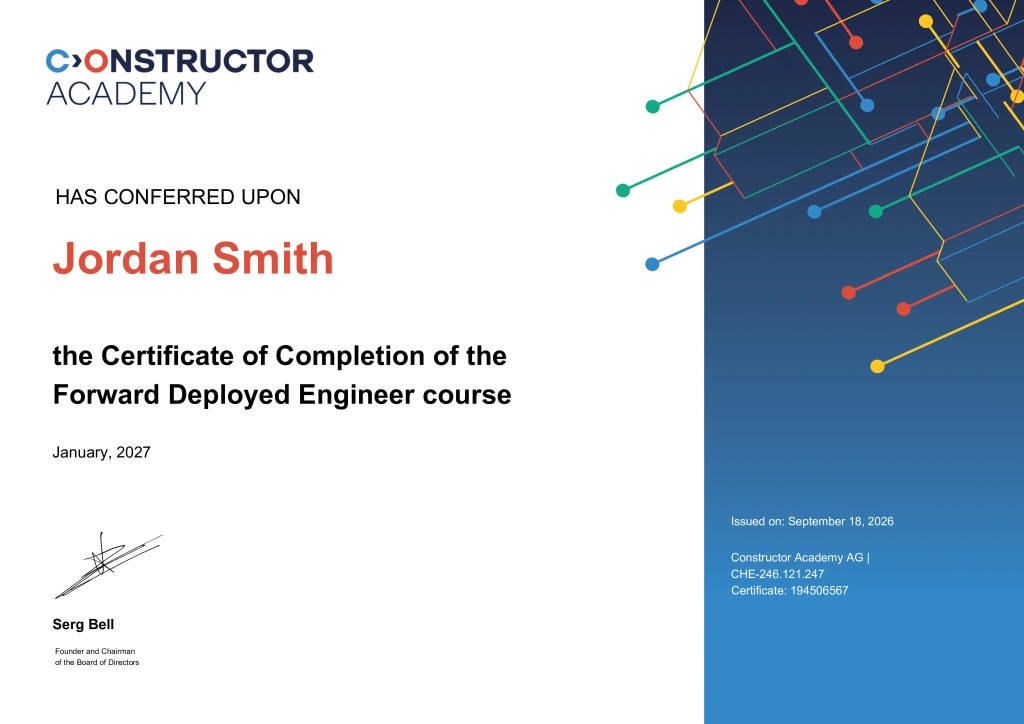
Certificate from a leading AI & Data Science academy

Showcase your achievement on LinkedIn, your CV and beyond. Your Constructor Nexademy certificate tells employers you've mastered in-demand skills through hands-on, real-world projects, and helps you take the next step in your career.
Certificate